When does the right to freedom of speech become a burden? In American society, the right to free speech, freedom of assembly, and freedom of expression are assumed from birth. As Americans, these rights are entitled to each and every one of us, but is there a limit? If citizens have an issue, protests and rallies are an effective way to get their voices heard. Many situations can allow freedom of speech but can a line be drawn on an entitled right?
Freedom of speech happens to be one of the major issues being tackled by the US Supreme Court this term. While Albert Snyder mourned at his son Mathew Snyder’s funeral, a Marine Lave Corporal who was killed in Iraq in 2006, he was further victimized by members of a local Kansa Baptist church as they protested at the funeral.
Protesters held signs that said things like “Thank God for Dead Soldiers” while wearing shirts with the phrase “God Hates Fags” printed across the front. This kind of behavior is atrocious especially coming from a religious group. Where is the compassion for others? Where is the tolerance that religion promotes? A man was killed as a part of a collective effort to protect people like them, to keep them safe. Even though they might not have agreed with his lifestyle, the way they showed their opinions was tactless, distasteful, immoral, and not to mention it didn’t portray them as the Christians they would like to be seen as. Albert Snyder sued the Reverend Fred W. Phelps and his followers for intentional infliction of emotional distress and was awarded $5 million but the decision was overturned. The courts ruled that the church was covered by their 1st amendment right to freedom of speech. Snyder claims, “This is not freedom of speech, this is targeted harassment.” With this I completely agree.
Sue.Me.
Commentary by Kendra Mells
"Freedom Ain't Free"
"Freedom Ain't Free"
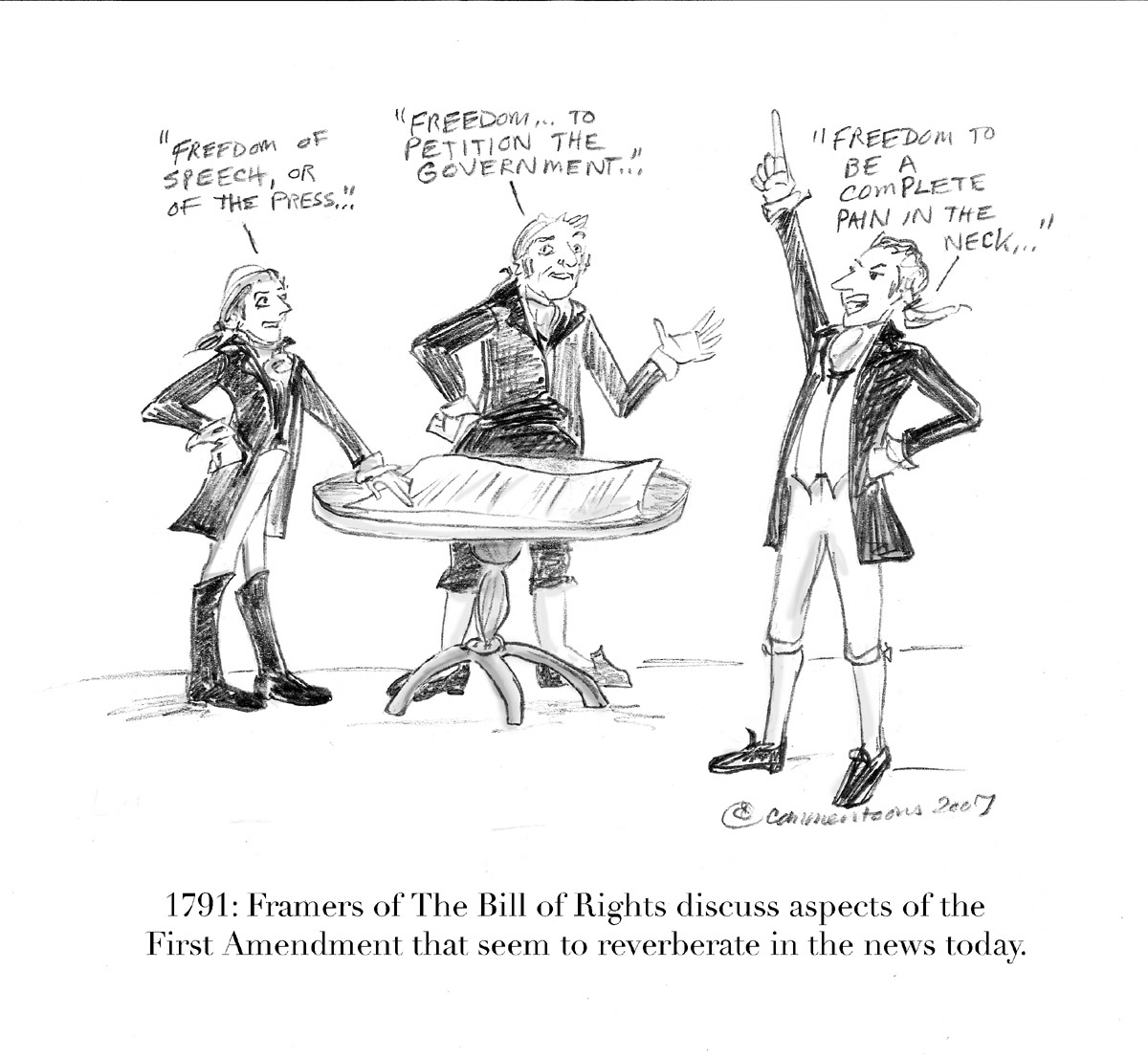
Freedom of Speech. Freedom to Assemble. Freedom of expression. Free. Free. FREE. These so-called "civil rights" are constantly being debated in modern day society to the point where they should be deemed "civil sources of unrest". The bottom line is, our American government has arranged for its citizens to be granted certain rights- BUT -it is the duty of both the governement and the citizens to ensure that these sensitive civil rights are enforced in such a manner as to not place the rights of any citizen over the rights of another. In fact, the above argument is making appeals to the prejudices of tehe people, rather than the actual situation at hand. Sound complicated? Exactly my point.
Each citizen realizes that he or she is granted these rights, but the government must make sure that the citizens knows that these rights stretch only as far as they can without infringing on the rights of another citizen. True, it was morally wrong of the protestors to infringe on the funeral of Snyder's son, but exactly which civil right of Snyder's did the protestors infringe on? Did they infringe on any rights at all? If no, then surely the courts were justified in overturning the suit, but if yes, then Snyder's award was completely justifiable. The true dilemma at hand, though, is not whether or not morals were in action with either party- it is instead whether not official civil rights were being violated by any party. As much as we all want for the good guys to win all the time, sometimes good or bad is not the issue at hand. Sometimes, the bad guys win, regardless of their moral standings. In other words, of course a line can be drawn on civil rights- it must be drawn to ensure that everyone is granted their rights. That, my friends, is the beauty of democracy!